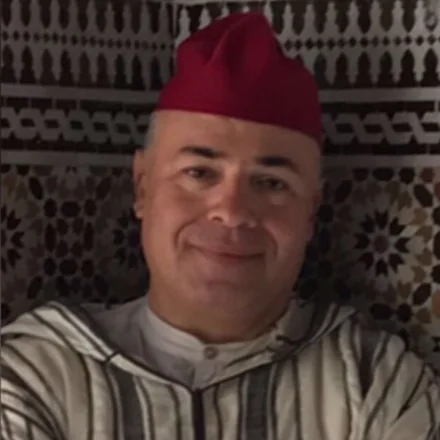

If you only have a few days in Marrakech, spend most of them inside the old walled medina: the square at Jemaa el-Fnaa, the souks behind it, one or two of the palaces, and one garden to sit in when the heat gets heavy. Everything else is a bonus. Below is how we would group it, area by area, the way Ben actually walks it with guests.
Bine Bine Abdelhai, known to his guests as Ben-Ben, runs Kesh Tours. He has lived in Marrakech his whole life and has been showing visitors around for decades. His line is that no two tours here are alike, and that is not a sales pitch, it is a scheduling problem. What follows is a map of the choices.
Start inside the medina
The medina is the walled old city, and it is where the great majority of what people picture as Marrakech actually is. It is a UNESCO World Heritage site. It is also a living neighborhood, so you will be walking past workshops, school children, and delivery mopeds, not through an exhibit.
Jemaa el-Fnaa
The big open square at the edge of the souks. In the morning it is fairly calm, with orange juice carts and a few performers. Through the afternoon it fills, and after sunset the food stalls are assembled and the whole square turns into an open-air dining room with smoke, drummers, storytellers and crowds.
Go twice: once in daylight to get your bearings, once at night. See our Jemaa el-Fnaa guide for how the square works and the etiquette around photos and tips.
The souks
North of the square, the covered markets run for what feels like miles. They are organized loosely by trade: metalworkers in one lane, leather slippers in another, dyers, woodturners, spice sellers. The layout is not random, but it is not signposted either, which is why people get turned around. Our Marrakech souks guide explains how the trades are arranged and how haggling actually works.
Medersa Ben Youssef
An old Islamic college built around a courtyard of carved cedar, stucco and zellij tilework, with tiny student rooms upstairs. It is one of the few pieces of historic religious architecture in the city that non-Muslims can go inside, and it is the one that makes people go quiet.
Palaces, tombs and townhouses
Marrakech has several grand houses open to the public, and they are different enough from each other that seeing two or three is not repetitive.
- Bahia Palace. A late nineteenth century palace built for a grand vizier, arranged as a sequence of courtyards and painted ceilings. The name means “brilliance.” It is large, and it gets busy.
- Dar El Bacha. The former residence of the pasha of Marrakech, now a museum, with some of the best tilework in the city and a calm central courtyard.
- The Marrakech Museum. Housed in a nineteenth century palace near the Medersa Ben Youssef, worth it as much for the building as the collection.
- The Saadian Tombs and El Badi Palace. The tombs are small, ornate and often crowded. El Badi next door is the opposite: a vast ruin, open to the sky, with storks nesting on the walls.
Gardens, and where to sit down
Marrakech is hot for much of the year, and the gardens are not a nice extra, they are how you pace a day.
Le Jardin Secret, in the middle of the medina, is a restored riad garden laid out in the old Islamic four-part plan, with a tower you can climb for a rooftop view over the old city. It is a short walk from the souks, which makes it a natural halfway stop.
Majorelle Garden, outside the medina walls in Gueliz, is the famous one: cobalt blue buildings, cactus and bamboo, and the Yves Saint Laurent museum next door. It is beautiful and it is popular, so it rewards planning. We wrote a full piece on Majorelle Garden and the YSL Museum.
The Menara gardens and the Agdal gardens are older, larger, plainer and far less visited: olive groves and irrigation basins, with the Atlas Mountains behind on a clear day.
Gueliz and the modern city
Gueliz is the new town, laid out during the French protectorate period, and it is where a lot of Marrakech actually lives and shops. Wide streets, cafes with sidewalk tables, galleries, and restaurants that are not aimed at visitors. If you have had three days of medina and want a quiet lunch and a normal coffee, this is where you go.
Things that involve leaving the city
If you have more than three days, one trip out of Marrakech changes the shape of the visit. The High Atlas foothills at Imlil or the Ourika Valley are an hour or so away. Essaouira, on the Atlantic, is a two and a half to three hour drive. The Ouzoud waterfalls are a similar distance inland. Each of these is a long but manageable day. We compare them in our guide to day trips from Marrakech.
The desert is a different proposition and deserves clear expectations, which is why we wrote desert tours from Marrakech separately.
The honest local view
A few things we would say plainly:
The tanneries are real and working, but the standard approach, where someone attaches himself to you on the street and leads you there, usually ends in a hard sell. Go with someone you arranged in advance, or skip it. We compare the options in private guide or group tour.
Camel rides in the palmeraie on the edge of the city are short and mostly photographic. There is nothing wrong with that, just know what you are buying.
Rooftop terraces are underrated. Almost every cafe around the square has one, and a mint tea buys you a seat and a view.
And the heat is the real planner. In July and August, the middle of the day is not for walking. Our guide to the best time to visit Marrakech goes through the seasons.
How Ben can help
Most people who write to us want the same thing: to see the important places without spending half the day lost or being steered into shops they did not ask for. That is what the Personalized Marrakech Tour is for. It runs about eight hours for one to five guests, starts with pickup at your hotel or riad, and covers the sites above according to what you actually want to see. Ben will tell you which ones to skip on a given day and why.
If food is the reason you came, the Taste of the Medina food tour is a four hour walk through the things Marrakech actually eats. If you want a mix, or you have a group, or you need transportation for a day outside the city, custom tours are arranged on request. Just get in touch and tell us your dates.
FAQ
How many days do you need in Marrakech?
Three full days is a comfortable amount of time to see the medina, the main palaces and gardens, and still take one trip outside the city. Two days is enough for the medina alone if you move at a steady pace. A week lets you add the Atlas Mountains, the coast, or the desert without rushing.
Can you see Marrakech on foot?
Most of the medina is walkable, and walking is the only way to see the souks properly since cars cannot enter the narrow lanes. For Majorelle Garden, Gueliz, the Menara gardens or the palmeraie you will want a taxi or a driver, since those sit outside the old walls.
Can non-Muslims go inside the Koutoubia Mosque?
No. In Morocco, working mosques are generally closed to non-Muslims, and the Koutoubia is a working mosque. You can walk the gardens around it and photograph the minaret freely, which is what most visitors come for anyway.
What is the single thing you should not miss?
Jemaa el-Fnaa at dusk, when the food stalls are set up and the square fills. It costs nothing to stand and watch. Ben usually times the end of a tour so you arrive as the light goes.