Buying a Moroccan rug is one of the real pleasures of a visit here, and also the purchase people most often get wrong. The two things that decide whether you are happy with it in five years are knowing what type of rug you are looking at and checking how it is made. Price comes third, and it is easier to judge once the first two are settled.
Ben has spent decades in these lanes, and personal shopping is part of what Kesh Tours does: rugs, furnishings, ceramics and lamps, with shipping worldwide. This is what he explains before anyone opens a wallet.
The main types of Moroccan rug
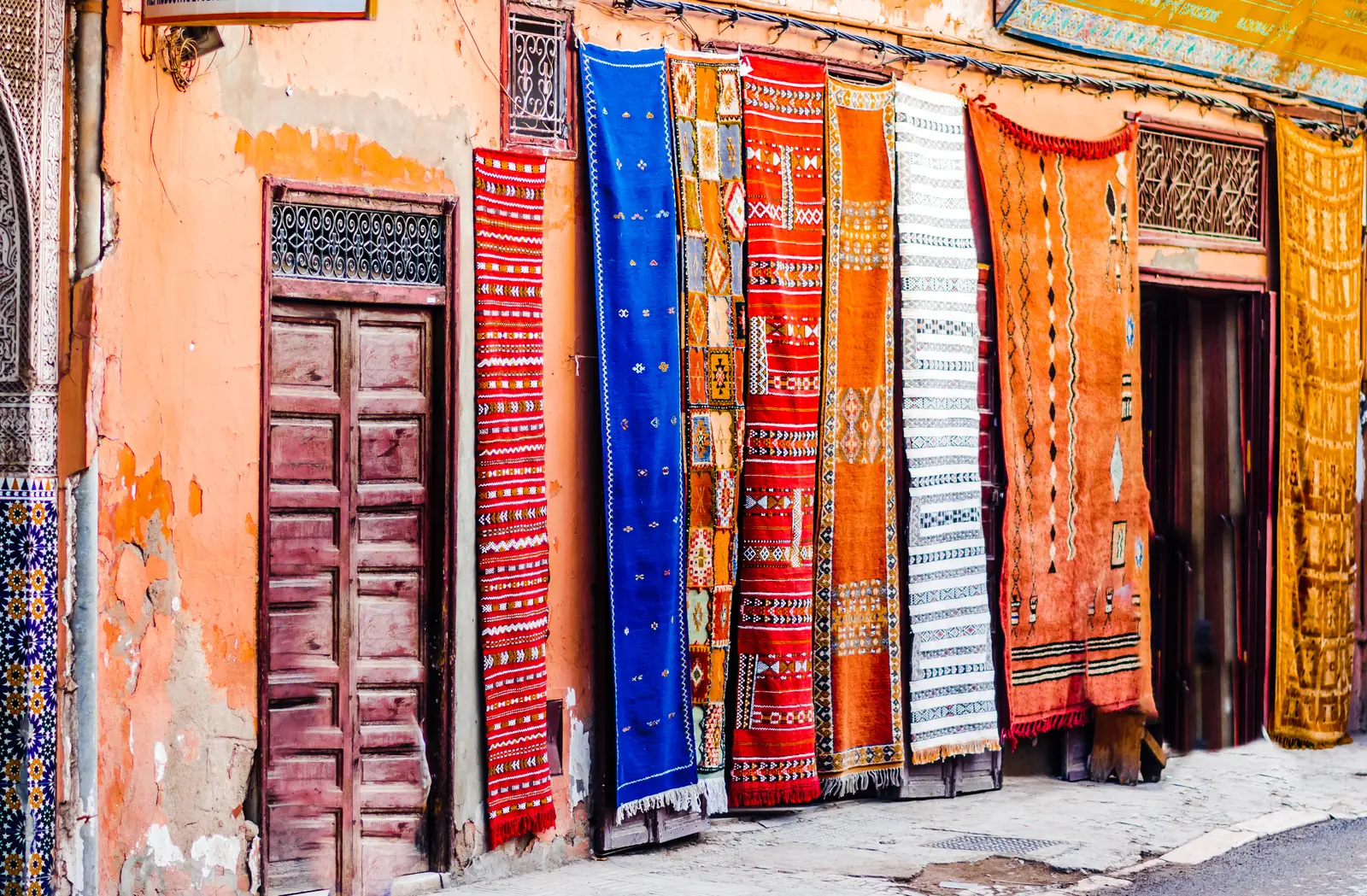
Beni Ourain. From the Middle Atlas. Thick, plush, usually undyed wool in cream or ivory, with sparse dark brown or black geometric lines, often diamonds or lozenges. This is the style that became ubiquitous in modern interiors, which means it is also the most widely copied and the most frequently made to order in colors that were never traditional.
Azilal. From the High Atlas around the town of Azilal. Generally thinner than a Beni Ourain, often woven on a cotton warp, with bright wool in irregular, improvised patterns, sometimes with figures and symbols scattered across a pale ground. No two are alike, which is the appeal.
Boucherouite. Rag rugs, woven from recycled clothing, fabric scraps and whatever was on hand. Riotous color, no rules, and historically made by women for their own homes rather than for sale. They are the most personal of the group and the least predictable.
Kilim, also called hanbel. Flat woven rather than knotted, so thin, light and reversible. Bands of color and geometric motifs, easy to pack and to ship. The kilims from the Taznakht area southwest of Ouarzazate are often deep red.
Zanafi and mixed weaves. Flatweave with sections of knotted pile or raised relief work, often in black, white and gray. Quieter than the others.
There are many more regional styles, and dealers will use the names loosely. Ask where a rug is actually from.
What to check before you buy
Handle the rug. Do not buy it from across the room.
- The back. Hand knotted rugs show knots. Machine made rugs show a flat uniform weave, sometimes with a latex or glue backing. A glued backing is a clear sign of factory production.
- Regularity. Perfectly straight lines and identical repeats suggest a machine. Hand work wanders slightly. That wandering is the point.
- The fiber. Wool feels cool, slightly springy and faintly greasy from the lanolin. Synthetic fiber feels squeaky and slick, and it warms up in your hand. Wool has a distinct smell, especially if you rub it.
- The dyes. Ask whether the colors are natural or synthetic. Both are legitimate and both are sold, but they should be priced differently. Rub a damp white cloth on the pile to see whether color transfers.
- Condition. Look for moth damage, especially near the edges and the underside. Check that the fringes and selvedges are intact, since repairs there are expensive.
- Age. Old rugs and new rugs are both worth buying. Just know which you are being sold. Genuine age shows in uneven fading, patched repairs and softened wool, not in a uniformly worn surface.
- Size. Measure your room before you travel and carry the numbers. This is the most common regret.
How pricing actually works
There is no fixed price for a hand made rug, and that is not a trick. The price depends on the wool, the dye, the knot density, the size, the age, the region and how long it took, and a large, finely knotted old rug represents months of one person’s work.
The way the conversation goes: you are shown a stack, rugs are unrolled one by one across the floor, tea appears, and eventually a number is named. That number is an opening position. Yours will be too.
What we would tell you:
Decide what the rug is worth to you at home before you open your mouth. Open below that. Move in decreasing steps. If you reach your number and the answer is no, thank the dealer and leave. Walking away is normal and nobody is offended.
Do not treat it as a contest. The goal is a price you are both content with, on an object you will live with for years.
Also: be wary of a price that seems remarkably low for a large, supposedly hand knotted rug. It usually means machine made, synthetic fiber, or both. Our souks guide covers the general rules of bargaining.
Getting it home
Small kilims fold into a suitcase. Anything thick or large does not, and a big Beni Ourain is heavier than people expect.
Options, in the order most people use them:
- Take it with you. Rugs can be rolled and compressed. Check your airline’s baggage rules first.
- Air freight. Faster, more expensive, sensible for one or two pieces.
- Sea freight. Slower, far cheaper by volume, the right answer if you are buying several rugs or furniture as well.
Whichever you choose, get it in writing: dimensions, weight, carrier, tracking, and who handles customs at the destination. Import duty and taxes in your own country are separate from what you pay here, and they are your responsibility. Look up your own country’s rules before you commit to a large purchase.
Why a local buyer helps
The gap between the visitor price and the local price for the same rug is real, and it is not because anyone is being dishonest. It is because a merchant cannot know what you know, and the opening number reflects that.
Someone who lives here changes three things: which shops you are shown, whether the rug is what it is claimed to be, and where the conversation ends up. It also makes the whole thing far more enjoyable, because you can concentrate on choosing rather than defending.
How Ben can help
Personal shopping is a core part of what Kesh Tours does. Ben buys Berber rugs, furnishings, ceramics and lamps with and for clients, and arranges shipping worldwide. That works whether you are here in person and want someone alongside you, or you are furnishing a house from another country and need someone on the ground.
If you are visiting, the Personalized Marrakech Tour takes in the souks as part of a full day, so you can look before you commit. For a dedicated buying day or a larger order, arrange it through custom Marrakech tours or simply tell us what you are looking for, with your room dimensions and any photographs of your space. Also worth reading: what a Moroccan riad is, since riad interiors are where most of these pieces belong.
FAQ
How can you tell if a Moroccan rug is handmade?
Turn it over. A hand knotted rug shows individual knots on the back and the pattern reads through clearly, while a machine made rug has a uniform backing, sometimes with a glued or latex layer. Hand knotted rugs are also slightly irregular, with lines that wander and edges that are not perfectly straight.
What is the difference between a Beni Ourain and an Azilal rug?
Beni Ourain rugs come from the Middle Atlas and are typically thick undyed wool in cream or ivory with simple dark geometric lines. Azilal rugs come from the High Atlas, are usually thinner, often woven on a cotton base, and carry bright colors and freer, more improvised designs.
Can you ship a rug home from Marrakech?
Yes. Rugs are shipped from Morocco all the time, by air for speed or by sea for larger and heavier loads. Get the weight, the dimensions, the carrier and the paperwork in writing, and understand that import duties or taxes in your own country are separate and are your responsibility.
Is it rude to walk away without buying?
No. Walking away is a normal part of the conversation and no serious dealer takes offense. Accepting mint tea does not commit you to buying either. What is discouraged is negotiating hard on something you never intended to buy, or agreeing a price and then changing your mind.