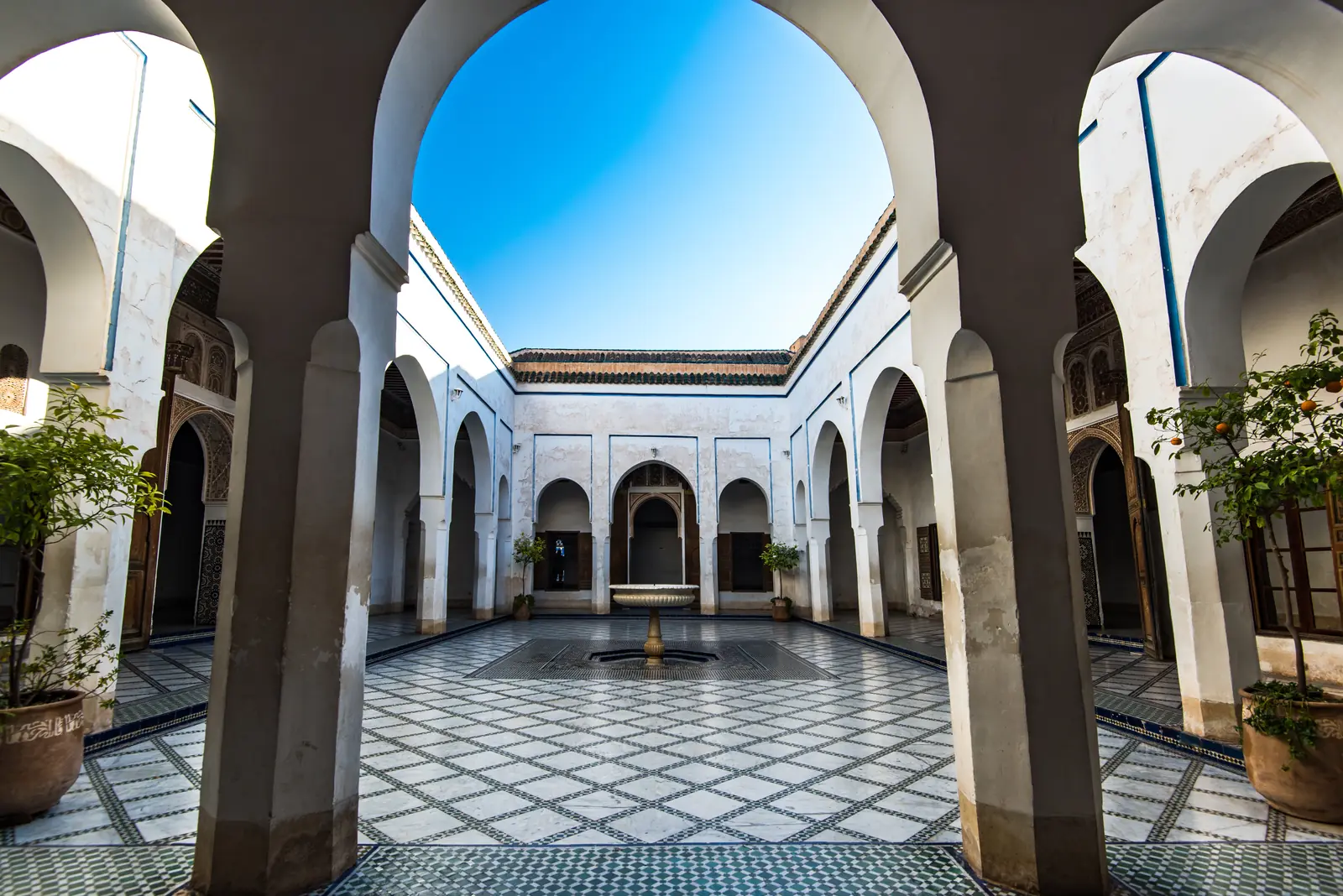
A riad is a traditional Moroccan townhouse built around an interior courtyard, with rooms facing inward onto the courtyard and almost nothing facing the street. The word comes from the Arabic for garden. Many have been converted into small guesthouses, which is why, in Marrakech, “riad” has become shorthand for a place to stay inside the old medina.
That inward design is not decoration. It is a response to heat, dust and privacy, and it is why a riad can feel ten degrees cooler and much quieter than the lane outside. Ben walks guests past dozens of blank riad walls every week, and the constant reaction is surprise at what is behind them.
The architecture, and why it is built that way
Walk down a medina lane and you see high walls, small doors, and very few windows. Step through one of those doors and you are in a courtyard open to the sky, usually with a fountain or a basin at the center, often with four planted quadrants around it, orange trees or bananas or jasmine, and galleries running around the upper floors.
The logic:
- Privacy. Family life happened inward, away from the street, and the entry is often bent so you cannot see into the courtyard from the door.
- Cooling. The courtyard acts as a chimney, drawing hot air up and out, while thick walls and shaded galleries keep the ground floor cool. Water adds evaporative cooling.
- Light. All the daylight arrives from above, which is why riad interiors have that soft, filtered quality.
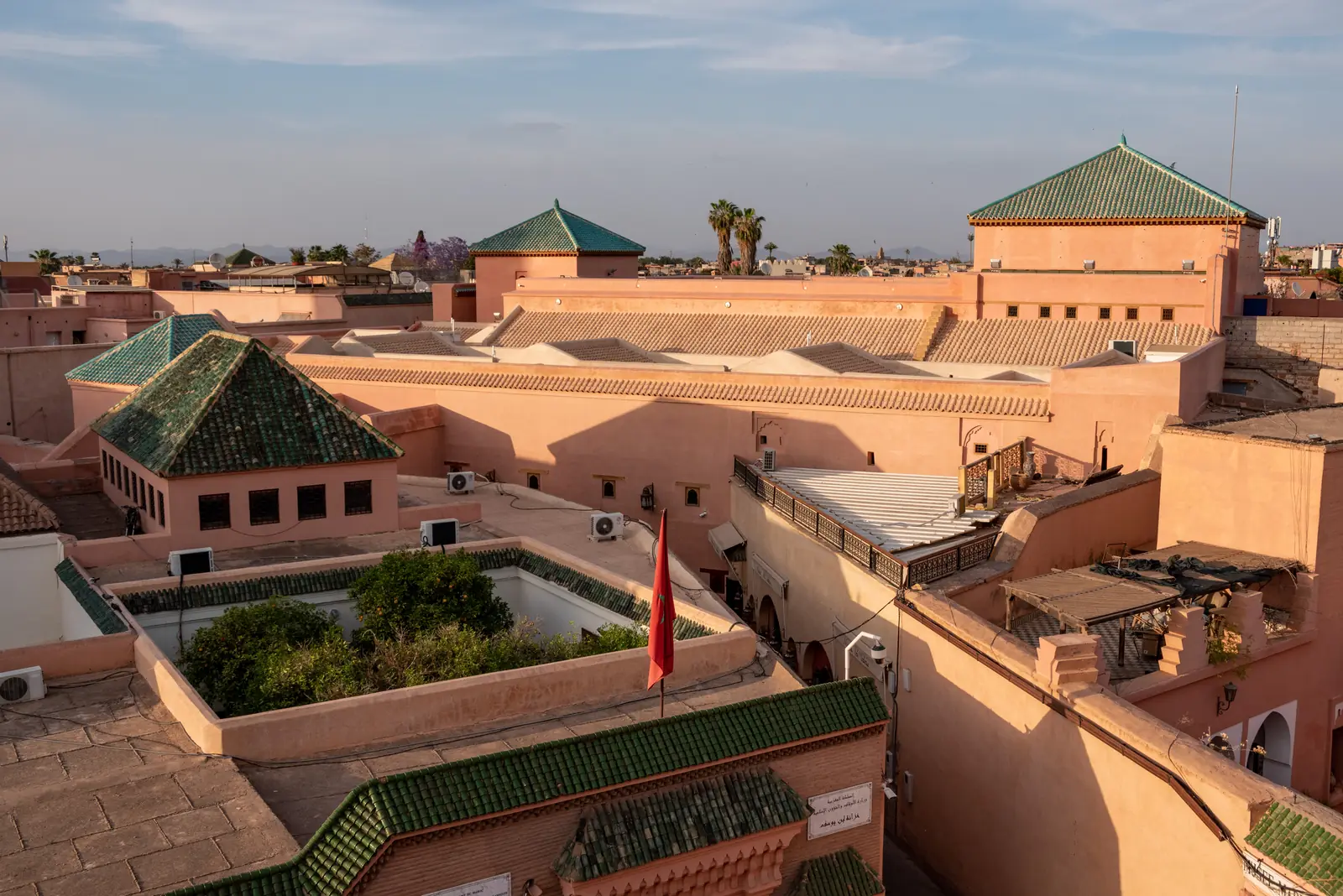
- The roof. Nearly every riad has a usable terrace, historically for drying laundry and sleeping on hot nights, now usually set with cushions and tables.
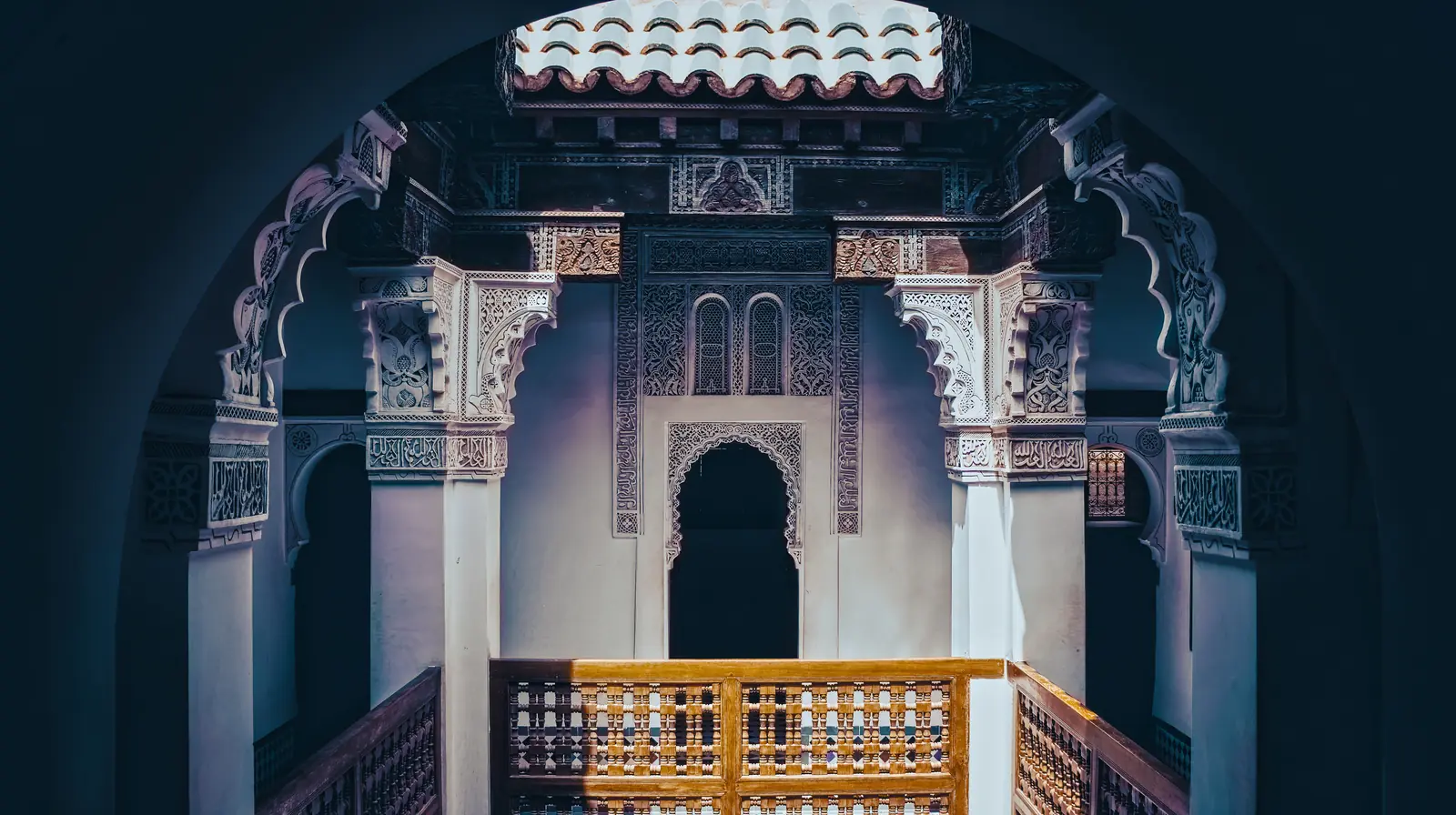
The surfaces inside are traditional crafts you will also meet in the souks: zellij tile mosaic, carved plaster, painted cedar ceilings, and tadelakt, the polished lime plaster used on bathroom walls because it resists water.
What staying in a riad is actually like
Most riads are small, often between three and ten rooms. There is usually no reception desk in the hotel sense, and often no elevator. Breakfast is generally served in the courtyard or on the terrace and is included: bread, msemen or beghrir pancakes, jam, olive oil, eggs, orange juice and mint tea, in some combination.
Rooms vary far more than in a hotel chain. In the same house you may find one large room with a fireplace and one small interior room with no outside window, at quite different prices. Look at the specific room, not just the property.
Things that regularly surprise first time guests:
- Stairs, often steep and often many. Ground floor rooms exist but are limited.
- Temperature. Courtyards are cool, which is wonderful in July and cold in January. Check for heating if you are visiting in winter.
- Sound travels. A courtyard is effectively a shared acoustic space.
- Many riads will cook dinner for you if you ask in advance, and it is frequently better than a restaurant.
- Pools, where they exist, are usually small plunge pools rather than swimming pools.
How to choose a riad in the medina
Location inside the medina matters more than a map pin suggests, because a straight line distance of 300 meters can be a ten minute walk through lanes.
Things worth checking before you book:
- How you get there with luggage. Ask for the nearest car drop point and whether someone will meet you. This is the single most common arrival problem.
- Which part of the medina. North of Jemaa el-Fnaa around Mouassine and Dar El Bacha is central and lively. The Kasbah quarter in the south, near the Saadian Tombs, is quieter. The far edges are calmer but add walking time at the end of a long day.
- Airport transfer. Many riads arrange it, and it removes the one moment where new arrivals most often get overcharged.
- Air conditioning and heating, by room, for summer and winter respectively.
- Whether the terrace is shaded. In summer this decides whether you can use it.
- Whether they serve alcohol. Many small riads do not, which is normal and worth knowing in advance rather than at dinner.
Ask questions by message before booking. A riad that answers clearly in advance usually looks after you well once you arrive.
Riad or hotel?
A riad gives you the medina, a short walk to the square and the souks, and a building that is part of what you came to see. A modern hotel in Gueliz or Hivernage gives you scale, lifts, parking, a proper pool and step free access.
Neither is the right answer for everyone. If someone in your party has trouble with stairs or uneven ground, we would say Gueliz. If your reason for coming to Marrakech is the old city, we would say riad, every time. Our guide to things to do in Marrakech shows how much of the city is inside the walls.
Some visitors split it: a few nights in the medina, then a night or two in a resort on the edge of town to decompress before the flight.
How Ben can help
Ben picks guests up at their hotel or riad at the start of the day, and after decades of doing it he knows the lanes, the car access points, and which riad doors are impossible to find. If your booking confirmation gives an address that you cannot make sense of, send it to us before you arrive and we will tell you what it means on the ground.
The Personalized Marrakech Tour starts with pickup at your door, so your first morning does not begin with a navigation problem. If you are furnishing a riad of your own, or you saw a lamp or a rug in your guesthouse and want one like it, that is exactly what our personal shopping service does, including shipping home. Questions about neighborhoods before you book? Ask us, we would rather you stayed somewhere that suits you.
FAQ
What is the difference between a riad and a dar?
Strictly, a riad is a traditional house built around an interior garden courtyard, while a dar is a courtyard house without the garden, often with a smaller paved patio. In practice the words are used loosely today, and most small guesthouses in the medina are marketed as riads regardless.
Can a taxi drop you at your riad door?
Usually not. Most riads sit on lanes too narrow for cars, so a taxi will leave you at the nearest vehicle access point and you walk the last stretch. Good riads will arrange to meet you there, or send someone with a cart for luggage. Ask about this when you book. Our post on safety and getting around covers taxis in more detail.
Are riads noisy?
Riads face inward, so street noise is generally muted, but sound carries around a courtyard, so a room off the main patio can hear breakfast and conversation. Rooms on the upper floors or off a side landing are usually quieter. The call to prayer is audible across the medina, including before dawn.
Is it better to stay in a riad or a hotel in Gueliz?
A riad in the medina puts you inside the old city and within walking distance of the souks and the square, which is the reason most people come. A hotel in Gueliz gives you elevators, parking, pools and a taxi that reaches the door. Families with a lot of luggage or mobility needs often do better in Gueliz.